Equity Market Review

Mr. Shridatta Bhandwaldar
Chief Investment Officer – Equities.
Equity Market Update
- In the month of February 2026, Nifty 50 marginally decreased by 0.56% amid increase in crude oil prices coupled with weakness in the rupee and rising tensions between the U.S. and Iran. Worries about disruptions related to artificial intelligence also kept investors on the edge.
- Foreign Institutional Investors (FIIs) were net buyers in Indian equities to the tune of ₹ 22,614.65 crore.
- Gross Goods and Services Tax (GST) collections in February 2026 stood at Rs. 1.83 trillion, representing a 8.1% rise on a yearly basis and this points towards the growing trajectory of the Indian economy.
- The combined Index of Eight Core Industries (Refinery Products Industry, Electricity Industry, Steel Industry, Coal Industry, Crude Oil Industry, Natural Gas Industry, Cement Industry, Fertilizers Industry) rose 4.0% YoY in Jan 2026, following a 4.7% rise in Dec 2025. Cement posted the strongest growth at 10.7%, followed by steel at 9.9%, while crude oil and natural gas output declined by 5.8% and 5.0%, respectively.
- Though during the month, sentiment briefly improved after U.S. President announced a trade agreement with India that reduces U.S. tariffs on Indian goods to 18% from 50%, in exchange for India stopping Russian oil purchases and easing certain trade barriers.
- Globally, U.S. equity markets advanced after the U.S. Supreme Court struck down most of the President’s sweeping global tariffs, delivering a major blow to the administration’s signature economic policy. European equity markets increased as investors reacted to corporate earnings announcements. In addition, value buying following recent declines contributed to the markets’ upward momentum. Asian equity markets ended the week on a mixed note. Markets rose as precious metals clawed back some ground following a historic sell-off.
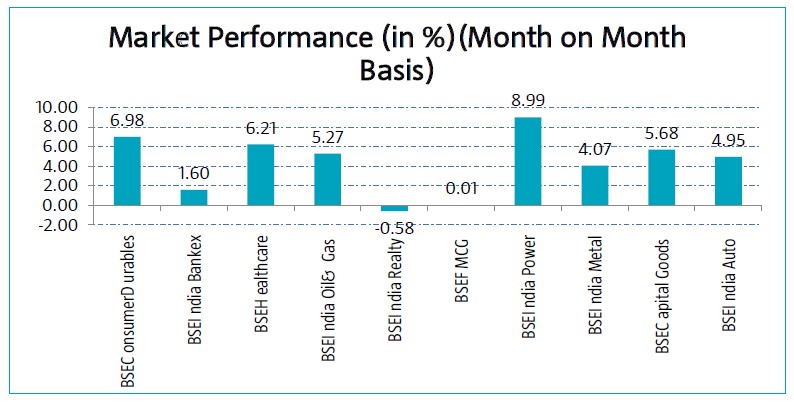
Note: The past performance may or may not be sustained in the future.
Source: MFI Explorer, ICRA Analytics Ltd. Data as on: 27th February, 2026
Equity Market Outlook
The world has moved from impact of tariffs to the impact of war on the economy and the markets. Clearly the war and increase in energy prices may impact the economy and the markets in the short term. However, our base case remains that the markets come back from these events and almost always, in hindsight, it looks like it was a good opportunity to deploy in equities. Historical evidence suggest that the markets are at a much higher levels 18-24months down the line, post the events. We expect the same thing to happen post the current Iran-Israel-US conflict too. The only risk here is, if the war were to get prolonged, through energy channel – it can impact India’s CAD (Current Account Deficit) as well as earnings. As of now, the base case for us is that the war would not sustain beyond 4-6 weeks, given limited financial ability of Iran to sustain this war. China or Russia directly entering to support Iran war would be clearly a downside risk to markets, even from these levels.
While the world remains complex on tariffs and geopolitics, the India- EU deal and US-India (Phase I) trade deal is reducing complexity for exports. We are of the view that the India-US trade deal phase II is likely to get done soon; reducing some overhang on the FII flows and currency. US disengagement with the rest of the world on trade and geopolitics is clearly negative highlight of the CY25. It has bearing on geopolitics (like seen in Venezuela, Iran etc.), trade and global growth.
While the theory of US getting short-changed by its trading partners is debatable, there is little doubt that the country was amongst the biggest beneficiaries of globalisation. As the US dominance in the global economy increased, it benefited from global savings moving back to the US to fund its large fiscal and trade deficit at an interest rate of under 2-3% on an average for the past 15-20 years. On the other hand, the benefits of increased local manufacturing that is being perceived as one of the end goals of these tariffs may not be easy to materialise given ecosystem challenges. Global manufacturing supply chains have been established over the past 40-50 years and are almost impossible to move to the US easily without major disruptions and dollar devaluation. This is due to various limiting factors that US suffers from like lack of labour skillset and ecosystem to produce these products at competitive costs. Thus, in the near term, the strategy of stepping back from globalisation is likely to hurt US consumers as the cascading effect of these tariffs trickle down in the form of higher inflation, higher real interest rates and lower economic growth. If this scenario of global uncertainty elongates, then US might be in for a negative growth surprise, when high headline inflation leaves limited room for the Federal Reserve (Fed) to cut rate beyond current expectations of 25-50bps in CY26.
U.S President’s policies so far are indicating their inward focus with a multi-polar world and disregard for global trade and defence agreements of previous US establishments. We thus expect uncertainty to prevail both on global growth and capital flows for Emerging markets including India. One possibility is that it may quickly lead to a US recession potentially easing monetary policy, Fed providing liquidity and faster interest rate cuts. US dollar could depreciate under such circumstances, which could be positive for Emerging markets over next 3-4 quarters. After strengthening initially post elections - the dollar index has depreciated over last 12 months indicating possible flows moving towards Emerging markets and Europe. Euro area might be an eventual beneficiary of this environment as it finally moves towards policies which make it a better economic and geopolitical zone. European leaders have been forced to make serious choices for the first time in last several decades. They may start looking towards East more and India could be beneficiary of the same along with China and Others. Geopolitics remains complex and you might get bouts of escalation and de-escalation periodically in our view (read Venezuela and Iran Currently). China continues to have challenges on growth revival due to ageing population and leverage in households/Real estate, which are structural in our view. Biggest challenge in our worldview remains that, the US is wanting to reduce their trade deficit and no one else is willing to step up including China resulting in negative growth environment globally. Lower US trade deficit means lower earnings globally, since it means impacted exports for rest of the World.
Indian macro remains best among the large economies and cyclical growth is normalising from the last year. The last Gross Domestic Product (GDP) print came in at 7.4%, 7.8% and 8.2% in 4QFY25, 1QFY26 and 2QFY26 respectively, after weak prints of 5.4% and 6.2% respectively for 2Q/3QFY25. FY25 GDP growth came at 6.5% and FY26E is projected at 7.4% as per Reserve Bank of India. Current Account Deficit has improved significantly and is expected to be ~1.2% for FY26E. Most domestic macro and micro indicators remain steady. Given these aspects, despite the global geo-political and economic dark clouds, the domestic equity market remains focused on earnings. While the structural earning growth has been healthy at >15% CAGR (Compounded Annual Growth Rate) for FY20-24, FY25/26E has moderated to mid-high single digit, which is a cause of concern. Thankfully 9MFY26 earnings have been along the expected line of consensus at high single digit YoY. Monetary policy has become very accommodative, both in terms of system liquidity (vs FY25) as well as administrative majors around lending. 9MFY26 nifty earnings growth was ~8%YoY growth – directionally improving from previous quarters. We believe that FY25 was a cyclical slowdown driven by factors which have largely reversed and expect earnings to normalise in FY26E/27E to low-mid double digit. Govt capex and consumption boost, interest rate cuts and liquidity, good monsoon, rural real wages all are supportive of earnings recovery in FY26E/FY27E.
Our belief on domestic economic up-cycle stems from the fact that the enabling factors are in place,
1) Corporate and bank’s financials are in best possible shape to drive capex and credit respectively,
2) Consumer spending likely to normalize given our demographics and Government push.
3) Government is focused on creating enabling environment through reforms and direct fiscal interventions (GST cuts, Income tax cuts and state social welfare schemes add up to 1.5%-2% of GDP)
4) Real estate cycle still is in mid cycle with healthy balance sheets.
This makes us constructive on Indian equities with 3-5 years view. We believe that India is in a business cycle / credit growth / earnings cycle through FY26-28E – indicating a healthy earnings cycle from medium term perspective. Though, watch out for war related risk that has emanated lately in the middle east and its impact on energy prices.
Select Consumer discretionary and Financials, Pharma, industrials, Telecom, Hospital, Hotels, Aviation are witnessing a healthy earnings cycle whereas FMCG, Commodities and IT continue to face headwind. Indian equity market trades at 19.5xFY27E/17.5xFY28E consensus Nifty earnings – in a fair valuation zone from medium term perspective – given longevity of earnings growth potential in India. For the broader market, while the last years correction has taken out the froth in mid-caps and small caps, they continue to trade at 10-15% premium to their own historical valuations – indicating that the strong earnings revival is a must for this part of the market to do well. Risk to market clearly remains from the war, if it were to get prolonged keeping elevated energy prices for longer than our base case for 4-6 weeks.
Source: ICRA MFI Explorer Bloomberg, Internal Research